RVG-BenchA Benchmark for Reasoning-Driven
Audio-Visual Temporal Grounding

1 AIM3 Lab, Renmin University of China2 Kling AI

* Project leader. † Corresponding author.

Abstract

Existing temporal video grounding (TVG) benchmarks primarily focus on localizing target video segments according to descriptive text queries of the visual content. However, real-world queries are more diverse and often require the model to first understand the user’s intent before localization, such as finding visual evidence, identifying the cause of an event, or recalling a remembered moment, yet such queries remain largely overlooked.

To mitigate this gap, we introduce RVG-Bench, a benchmark for reasoning-driven audio-visual temporal grounding, where every query is constructed such that the target segment can only be identified through reasoning about the query’s underlying intent. We carefully construct the benchmark and rigorously verify its data quality to ensure models truly comprehend the audio-visual content. RVG-Bench comprises 1,255 videos and 1,890 query-interval pairs across eight reasoning types.

We evaluate 22 models and find that the strongest, Qwen3.8-Omni-Flash, achieves only 49.6 mIoU. Through a series of controlled analyses, including oracle-grounding probes and test-time scaling experiments, we systematically examine where and why current models struggle, providing insights for future model development.
Overview

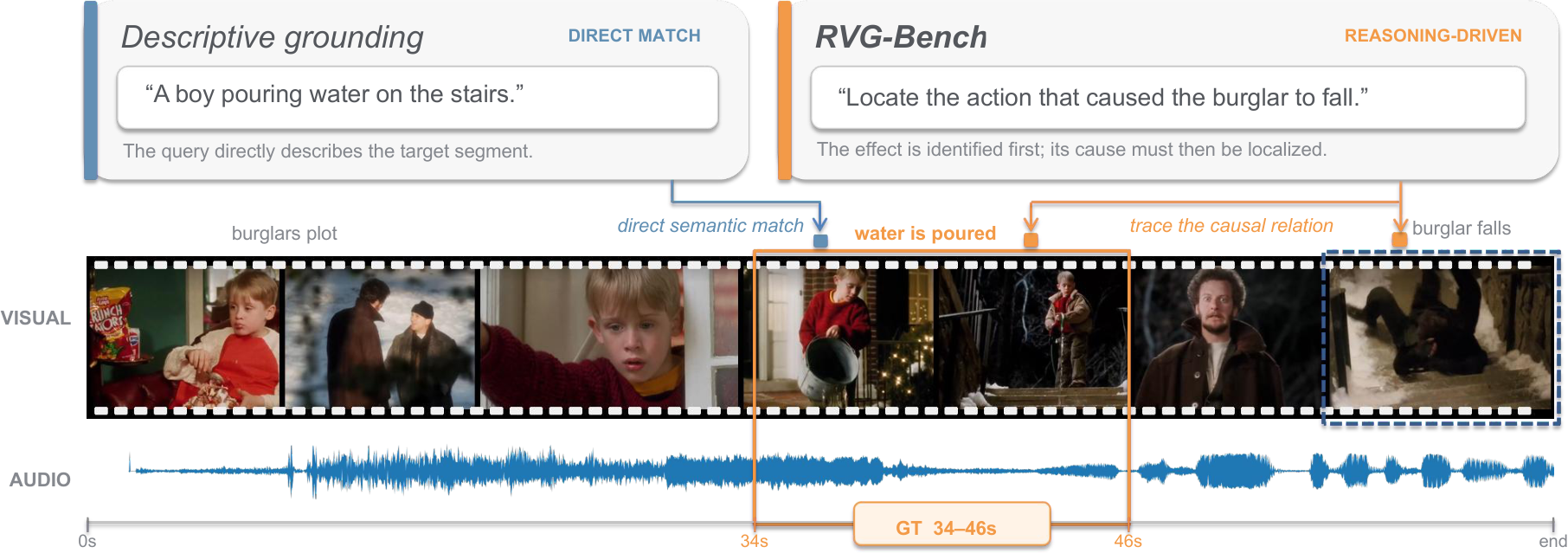
A query can describe an intent without naming the event. RVG-Bench asks a system to reason about what happened, resolve which event answers the query, and then localize it in time.

Comparison of descriptive and reasoning-driven grounding. A boy pours water on stairs; a later shot shows a burglar falling. The reasoning query asks for the action that caused the fall, requiring a link back to the earlier event.
From descriptive to reasoning-driven grounding. The target event is inferred from the query’s intent using visual and audio evidence.

Example query: “Locate the action that caused the burglar to fall.” The model must recognize the outcome, trace its cause, and localize the earlier action.

Benchmark

RVG-Bench contains 1,255 videos and 1,890 query–interval pairs, covering eight single-step reasoning types and 302 multi-step queries.

Intrinsic attributes
Infer what an event implies: a character’s mental state, an unexpected occurrence, or a symbolic meaning. Includes character-centric, anomaly, and symbolic reasoning.
Relative attributes
Compare candidate moments or reason about their positions in a sequence to identify the target. Includes comparative and ordinal reasoning.
Relations between events
Follow causal, temporal, or referential connections from the event in the query to the target event. Includes causal, sequential, and referential reasoning.

Multi-step reasoning combines two or more of these operations within a single query.

Main Results

Evaluation of 22 models under Chain-of-Thought (CoT) prompting, covering eight single-step reasoning types and multi-step queries.

Scroll horizontally to view all columns.

Main results on RVG-Bench
Model Input S-Step M-Step Overall
CausSeqRefCharAnomSymbCompOrdOverallmIoUmIoUIoU@0.3
API-based models
Qwen3.8-Omni-FlashAV38.571.147.141.943.858.662.951.951.340.649.668.0
Seed2.0-LiteAV36.864.250.240.044.656.266.742.749.036.947.062.6
Gemini-3-ProAV31.363.544.434.641.451.068.345.146.135.844.461.1
Seed2.0-ProV28.957.942.336.440.848.858.636.842.638.041.958.2
GPT-5.5V28.250.938.032.843.447.950.132.639.532.838.555.5
Qwen3.8-FlashV26.548.140.633.431.549.257.933.738.636.238.252.8
Locally evaluated omni models
ChronusOmniAV13.137.313.824.222.726.041.626.225.015.723.433.4
Qwen3-OmniAV11.115.29.810.64.614.523.79.512.22.810.714.4
Qwen2.5-OmniAV5.17.15.85.16.17.38.12.95.81.45.17.3
HumanOmniV2AV3.25.59.73.28.310.57.56.16.10.35.17.1
Ola-7BAV3.83.64.43.95.09.87.44.84.92.44.56.1
MiniCPM-O-2.6AV1.31.02.31.42.53.74.21.52.03.32.22.7
Locally evaluated VL models
TimeLens-8BV19.744.126.529.327.043.943.729.331.921.330.141.7
Qwen3-VL-8BV14.541.024.321.826.847.638.425.028.316.426.335.0
TimeLens-7BV13.033.916.821.220.535.535.620.023.513.121.831.1
Time-R1-7BV14.428.516.719.015.025.534.320.221.112.719.729.4
TRACEV12.718.212.613.76.021.125.212.414.910.114.120.8
Qwen2.5-VL-7BV11.221.713.512.69.218.224.816.315.62.313.420.4
VideoChat-R1V16.411.510.711.48.217.317.110.513.06.611.917.4
TimeSuiteV5.513.86.68.210.915.120.59.410.63.69.413.8
Video-R1-7BV7.08.17.94.16.911.99.75.07.31.86.49.3
MiMo-VL-7B-RLV2.60.83.22.01.33.52.31.12.00.21.72.4
Human reference on the validated audit subset
Human baselineAV63.985.671.758.856.674.269.467.968.552.465.378.5

Metrics. Input denotes visual (V) or audio-visual (AV) input. S-Step and M-Step denote single- and multi-step reasoning. All numeric values are percentages; every score column reports mIoU except IoU@0.3 (recall at IoU ≥ 0.3). Higher is better. Overall scores are sample-count-weighted.

Types. Caus: causal; Seq: sequential; Ref: referential; Char: character-centric; Anom: contextual anomaly; Symb: symbolic; Comp: comparative; Ord: ordinal.

Human reference. Two annotators independently evaluate a separate stratified subset of 200 queries: 20 per single-step type and 40 multi-step. Their IoUs with the ground truth are averaged per query before aggregation.

Example Cases

Four examples from the final benchmark. Watch the full video for context, or play the reference interval to see the target event.

Relational reasoning

Causal reasoning

Query: What is the key deceptive action that secretly causes the ball to be under the cup for the final reveal?

Reference interval: 00:09–00:12 Visual evidence

Reference answer: The magician turns the cup upside down and places it on the table, but intentionally does not pour the ball out, trapping it inside.

Intrinsic-attribute reasoning

Character-centric reasoning

Query: At what point does the red and black train, Victor, show a clear sign of exasperation?

Reference interval: 00:10–00:11 Audio + visual evidence

Reference answer: Immediately after a crane hook crashes and the operator apologizes, Victor looks up and lets out an exasperated sigh.

Relative-attribute reasoning

Ordinal reasoning

Query: Locate the last time the boy speaks into his walkie-talkie during their mission.

Reference interval: 00:54–00:55 Audio + visual evidence

Reference answer: While hiding in the closet, the boy replies 'Copy that' into his walkie-talkie just before scrambling to escape.

Compositional reasoning

Multi-step reasoning

Query: When does the protagonist discover that the supernatural mechanism has failed to produce the result observed in her earlier experiments?

Reference interval: 01:36–01:40 Visual evidence

Reference answer: The protagonist realizes the supernatural mechanism has failed when she opens the closet door to find her husband has completely vanished. In her earlier experiments, she had placed a hanger and a doll into the closet and observed that both items multiplied. Relying on this established pattern, she playfully convinced her husband to step inside, expecting him to duplicate as well. Instead, seeing the visibly empty closet confirms a shocking deviation from the rule, instantly turning her mischievous expression into genuine concern.